
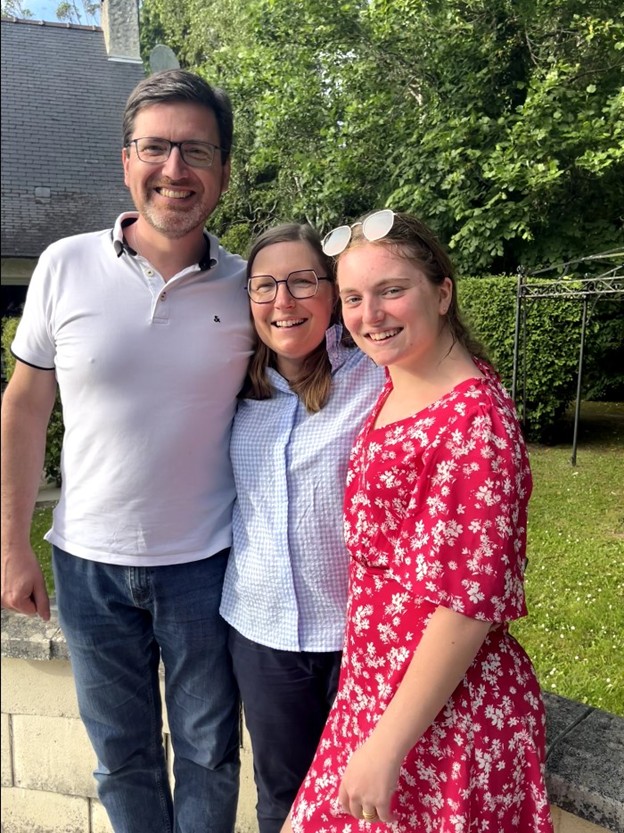
Céline’s Journey: Perseverance, Resilience, and Hope
Our Family’s Story and Commitment to AMRYC (Association for Hereditary Cardiac Rhythm Disorders)
Introduction: Presenting Céline and Our Family Context
I’m Sophie Pierre, vice-president of AMRYC (France) which aims at supporting all patients suffering from inherited cardiac rhythmic diseases (long and short QT syndromes, Brugada syndrome, Catecholaminergic Polymorphic Ventricular tachycardia, early repolarization syndrome..). Today, I am honored to share with you the story of Céline, our beloved daughter and the third child in our family.
When I earned my PhD in Virology and Molecular Biology in 2002, I never could have imagined that my academic pursuit would one day turn into such a deeply personal journey. The knowledge and experience I gained have not only shaped my professional life but have also become essential in navigating the challenges our family has faced, especially with Céline’s condition.
Our journey with Céline has been marked by extraordinary challenges, unwavering love, and deep involvement with the Association for Hereditary Cardiac Rhythm Disorders.
The Abrupt Beginning: Céline’s Birth and Initial Medical Concerns
Céline’s story began on January 23, 2009, at her birth—a moment that should have been filled with celebration but instead was overshadowed by concern. Born 2 months before her term with a severe bradycardia (Doctors thought of foetal distress at that time), Céline’s arrival was abrupt and fraught with uncertainty. The medical team was worried, and so were we, as parents. I couldn’t see her before 3 days as she was immediately transferred to an intensive care unit where she stayed one full month; We didn’t know what the future would hold, or if Céline would survive her first year.
A Decisive Medical Partnership
Our journey took turn in May 2009 when we met a dedicated inherited rhythmic disease specialist at Necker Hospital. She discovered Céline was suffering from a rare hereditary cardiac rhythm disorder known as short QT syndrome type 2. This disease was unfamiliar to most doctors and terrifying in its uncertainty.
This meeting was decisive for Céline’s care and our family’s future. The dedicated pediatric cardiologist not only provided expert medical guidance but also learned about the disease alongside Céline as she grew. Together, we navigated unknown territory, building a partnership based on trust, learning, and hope.
After 17 years, she still takes care of Céline now in Marie Lannelongue Hospital and we express to her our deepest gratitude for everything that has been done for Céline over the past seventeen years. Her ongoing care, attention, and willingness to accommodate Céline’s unique needs have made an immeasurable difference in her daily life. With time and experience, we have learned that there are only 19 published cases of short QT syndrome type 2 worldwide. Our family’s journey is not just personal, it is part of a global story of rare diseases, medical discovery, and hope for the future.
Family Resilience: Coping with Uncertainty and Fear
Throughout these years, our family has learned to cope with uncertainty, fear, and the ever-present possibility of sudden loss. We have discovered reserves of strength we never knew we had. Living with short QT syndrome type 2 meant adapting every day to the unknown. We managed the evolving challenges of the disease, always mindful of the risk of sudden cardiac events. By the time Céline was three years old, we got a defibrillator at home—a constant reminder of the fragility of life. Céline’s courage has inspired us all to face each day with hope, gratitude, and a determination to cherish every moment together.
Vestibular Areflexia: Additional Challenges
Céline’s journey was complicated further by bilateral vestibular areflexia, another rare condition linked to the same genetic mutation. This brought additional challenges to her development and daily life, demanding even greater adaptation and resilience from our family.
Association Involvement: Commitment to Raising Awareness and Supporting Others
Our personal experience led us to become deeply involved with AMRYC. Through the association, we strive to raise awareness about inherited cardiac diseases, support other families facing similar challenges, and advocate for research and better care & Quality of Life. This commitment is a way to transform our journey into a source of hope and help for others.
AMRYC commitment led us to actively promote cardiac emergency awareness and first aid training in schools and sports facilities, empowering communities to respond swiftly during crises. We also advocated for installing AEDs at local sports venues to enhance safety and protect children with rare cardiac conditions.
Involvement, Perseverance & Resilience: a never-ending journey
Alongside Céline’s medical journey, our family also faces the challenges of Céline’s sister’s psychiatric disease, which adds another layer of complexity to our daily lives and anxiety for Céline as well. Additionally, I carry the familial BRCA2 mutation inherited from my mother, a genetic risk that exposes us to breast, ovarian, and pancreatic cancers. Céline also has one chance out of 2 to have this additional deleterious mutation.
Before concluding, I would like to mention the “3 days in one challenge” I face every day as other mothers taking care of disabled children : balancing my full-time role as Director of Scientific Affairs in a Diagnostic Company, caring for my beloved family, and managing the triplicate combination of cancer, cardiac disease, and psychiatric illness in the current challenging French medical care environment. Navigating these responsibilities requires constant adaptation and resilience, but I am determined to do my best for those I love and for helping other patients.
Conclusion: A Message of Hope
Céline’s story is one of challenges, uncertainty, and adaptation—but above all, it is a story of love, hope, and family resilience. We are grateful for the support of our medical team, especially Céline’s truly dedicated cardiologist and for the community we have found through the association, especially Françoise Pélissier, AMRYC’s current president. By sharing our journey, we hope to inspire others to cherish their loved ones, support those facing rare diseases, and never lose sight of hope.